Predictive vs Corrective Maintenance: Which Is Better?
In fleet management, choosing the right type of maintenance is a decision that directly impacts costs, safety, and vehicle availability. Two of the most well-known approaches are predictive maintenance and corrective maintenance, each with advantages and limitations.
While predictive relies on technology and data analysis to intervene before a failure occurs, corrective waits until the breakdown is evident to repair it. The key is understanding their differences and deciding which to apply based on the fleet profile and needs.
What is predictive maintenance
Predictive maintenance uses sensor data, telemetry, and statistical analysis to predict when a component will fail. Fixed intervals are not followed; instead, action is taken based on the actual condition of each part or system.
Example: A sensor detects that a bearing temperature is rising above normal. Before it breaks, a replacement is scheduled.
Advantages:
- Reduces unscheduled downtime.
- Extends component lifespan.
- Improves safety.
- Optimizes spare parts usage.
Disadvantages:
- Requires initial technology investment.
- Needs team training.
What is corrective maintenance
Corrective maintenance consists of repairing equipment or a vehicle after the failure has already occurred. It can be planned (if something is detected as failing but the vehicle remains operational) or unplanned (when it occurs unexpectedly).
Example: A truck stops because the timing belt broke. The vehicle is out of service until repaired.
Advantages:
- No prior technology investment required.
- Useful for low-cost or easily replaceable parts.
Disadvantages:
- Greater downtime.
- More costly repairs.
- Risk of secondary damage.
Negative impact on service and company image.

History and evolution in the sector
- Past decades: Corrective maintenance predominated, as monitoring technology was expensive or nonexistent.
- 2000s: The first on-board diagnostic systems (OBD) and basic preventive maintenance software appeared.
- Today: With IoT sensors, fleet management platforms, and cloud analytics, predictive maintenance is increasingly accessible.
Real savings cases
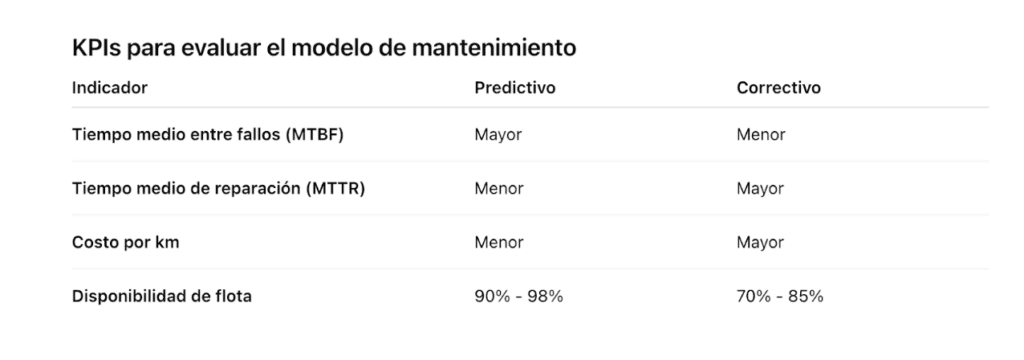
A transport company with 150 trucks shifted from an 80% corrective / 20% preventive scheme to 60% predictive / 40% corrective.
Results in 12 months:
- 35% reduction in serious breakdowns.
- 22% savings in repair costs.
- 18% increase in operational availability.
Checklist for implementing predictive maintenance
- Define critical vehicles and components.
- Install appropriate sensors (temperature, vibration, pressure).
- Integrate data into a management platform.
- Train staff in data interpretation.
- Establish immediate intervention protocols.
- Measure results and adjust the plan.
When to choose each one
- Predictive: Large fleets, high asset value, critical routes.
- Corrective: Secondary vehicles, low repair cost, low operational criticality.
Combined strategy
Most of the most efficient transport companies do not choose between one or the other. They combine both approaches according to the criticality of each asset.
A balanced model could be:
- 70% predictive for engine, transmission, brakes, tires.
- 30% corrective for minor items: lighting, mirrors, accessories.
Conclusion
The answer to “which is better?” is not absolute. It depends on the fleet type, available resources, and maintenance strategy.
However, with advances in IoT, artificial intelligence, and fleet management platforms, predictive is more cost-effective in the long run, but corrective still has a place in a balanced strategy.