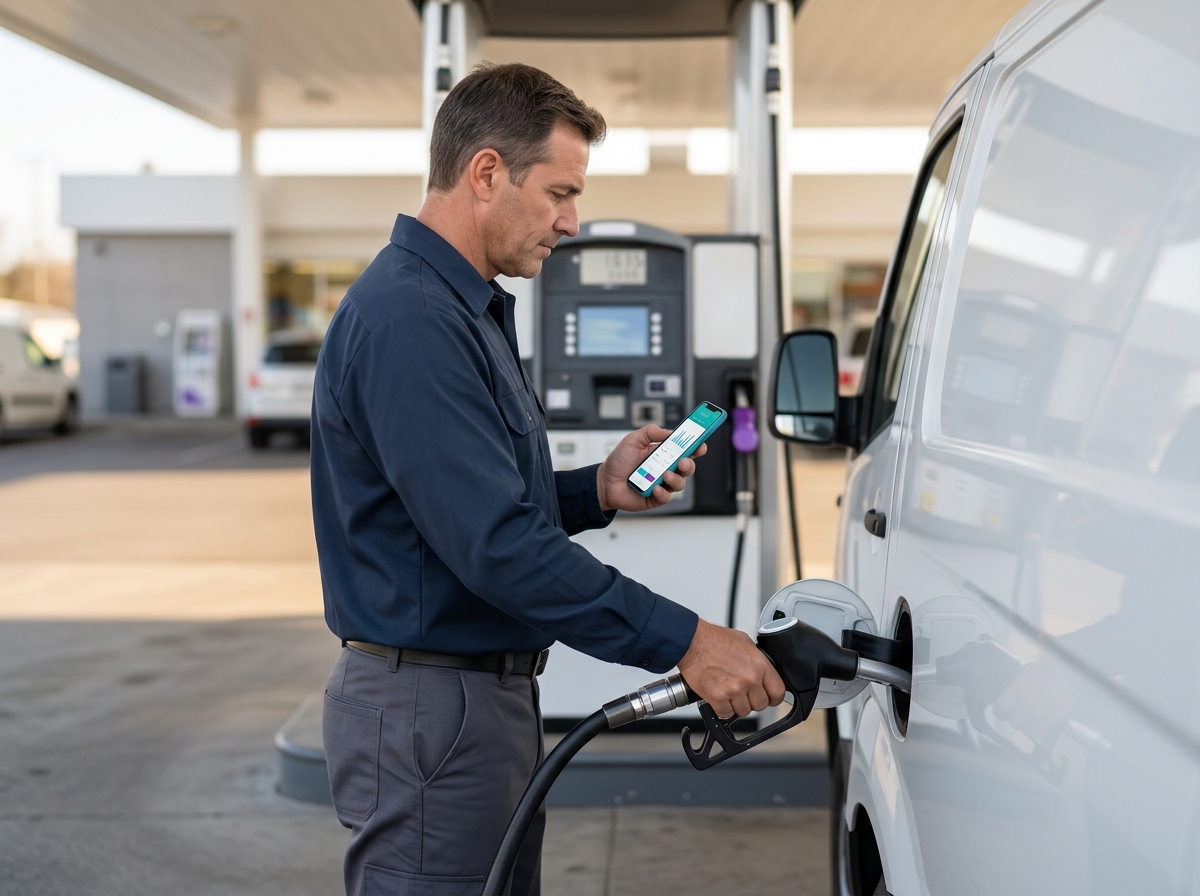
To detect irregular fuel fills in a fleet, record each fill per vehicle and compare it with mileage, tank capacity and expected fuel efficiency. Fills that do not match those data points are flagged as alerts and reviewed. Without that cross-check, losses are discovered at month end, when the cost has already been paid.
Last updated: October 2026
What counts as an irregular fill?
It is a fill that departs from what is expected for that vehicle. The most common cases are a volume larger than the tank capacity, several fills within a few hours, fills outside the route or working hours, and fuel efficiency per mile that differs sharply from the same vehicle’s history.
What data needs to be recorded?
- Vehicle and driver who made the fill.
- Date, time and location of the fill.
- Gallons or liters and amount paid.
- Odometer or hour meter reading at the time of the fill.
- Fuel type and payment method.
With those five data points you can already calculate efficiency per vehicle and detect deviations.
How are deviations detected?
| Validation | What it compares | Warning sign |
|---|---|---|
| Tank capacity | Volume filled against vehicle capacity | Fill larger than the tank |
| Frequency | Time between consecutive fills | Fills very close together |
| Fuel efficiency | Miles per gallon against the historical average | Sustained or sudden drop |
| Route and schedule | Location and time against the assigned operation | Fill outside the zone or shift |
| Mileage | Reported odometer against expected distance | Odometer that does not advance or goes backward |
What process is worth setting up?
Start by digitizing the record, either with an integrated fuel card or with entries from the driver’s phone. Then define alert thresholds by vehicle type, assign someone to review each alert and document the result. Over time, the thresholds are adjusted to reduce false positives.
Which indicators should you track?
The most useful are efficiency per vehicle and per driver, fuel cost per mile, the number of alerts per month, the share of confirmed alerts and the volume observed per week against the expected volume.
Frequently asked questions
Can you control fuel without a card? Yes. Driver entries validated against mileage already give good signals, and a card adds traceability.
What should I do when an alert fires? Review it with the driver and the fleet manager, document the reason and, if needed, correct the record or take action.
Does fuel control integrate with the rest of the fleet? It should, so it can be cross-checked with mileage, maintenance and cost per vehicle in the same reports.
To see how fuel control works, request a demo or explore the fleet management platform.